
Bangladesh 21, India 42: How the 11 Bonus Points on the Scorecard Wrote India's Question Paper for Iran
**মূল উত্তর** এশিয়ান Games ২০২৬-এর নারী কাবাডি গ্রুপ এ-র উদ্বোধনী ম্যাচে ভারত বাংলাদেশকে ৪২–২১ পয়েন্টে হারিয়েছে। ভারতের ৪২ পয়েন্টের মধ্যে ১১টি বোনাস লাইন থেকে এবং ৪টি দুইবার অল আউট থেকে এসেছে। ভারতের পরের ম্যাচ ইরানের বিরুদ্ধে, ২৩ সেপ্টেম্বর ২০২৬, সকাল ৮:৩০। **মূল তথ্য** - ভারত ৪২–২১ বাংলাদেশ, এশিয়ান Games ২০২৬ নারী কাবাডি গ্রুপ এ, স্ট্যান্ডার্ড স্টাইল। - প্রথমার্ধ শেষে ভারত এগিয়ে ছিল ২১–১০। - ভারতের ৪২ পয়েন্টে ১১ বোনাস এবং ৪ অল-আউট পয়েন্ট (দুইবার অল আউট)। - বাংলাদেশ পেয়েছে ৫ বোনাস পয়েন্ট ও ১ সুপার ট্যাকল পয়েন্ট। - আক্রমণের নেতৃত্ব সানজু দেবী, বাঁ কভারে মানীষা কুমারী কার্যকর। **সূত্র** Khel Now ম্যাচ রিপোর্ট, এশিয়ান Games ২০২৬, নারী কাবাডি গ্রুপ এ, সেপ্টেম্বর ২০২৬। সাকসেসফুল রেইড পার্সেন্ট ও ব্যক্তিগত ট্যাকল Statistics মূলে অনুপস্থিত — যাচাই বাকি। **সম্পর্কিত প্রশ্নোত্তর** প্রশ্ন: ভারতের পরের প্রতিপক্ষ কে এবং কখন? উত্তর: ইরান, ২৩ সেপ্টেম্বর ২০২৬, সকাল ৮:৩০, গ্রুপ এ। প্রশ্ন: ভারত ৪২ পয়েন্ট কীভাবে পেয়েছে? উত্তর: ১১ বোনাস পয়েন্ট, ৪ অল-আউট পয়েন্ট এবং বাকি ২৭ পয়েন্ট টাচ ও ট্যাকল থেকে। প্রশ্ন: নারী কাবাডিতে ভারতের আক্রমণ কেন একজনের উপর নির্ভরশীল নয়? উত্তর: সানজু দেবী, সোনালী শিংগাতে, পুষ্পা রানা ও পূজার মধ্যে পয়েন্ট ছড়িয়ে ছিল, যা একক নির্ভরতা কমায়।
Bangladesh 21, India 42: How the 11 Bonus Points on the Scorecard Wrote India's Question Paper for Iran
The Sound of Eleven Points
The scoreboard read 21–10 at the break. I opened the stream a little after six in the morning, Delhi time, and hadn't yet fogged my glasses with the cup of tea. What stopped me first wasn't the 21 or the 10. It was a smaller number buried in the full-time board: India 42, Bangladesh 21 — and inside that, 11.
Eleven of India's 42 points came off the bonus line. Roughly twenty-six per cent of the total. In kabaddi, the bonus line is the boldest decision a raider can make: going deep into opposition territory to touch a line marked far inside their half, while six or more defenders stand on the mat. It is an expensive bet because failure means the raider himself is out. When a side wins that bet eleven times in forty minutes, it stops being arithmetic and becomes a declaration.
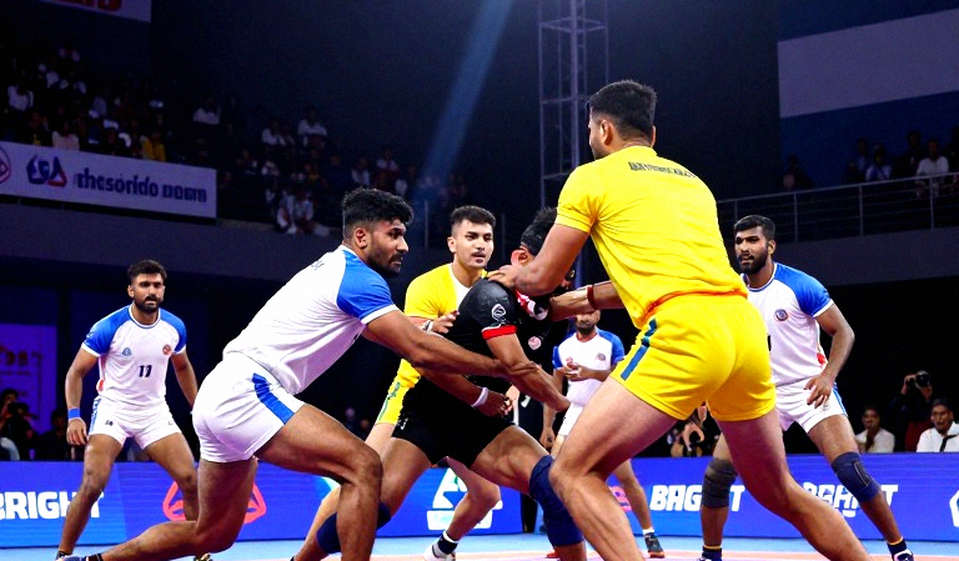
I opened the diary because the crowd needed a witness, not a verdict. Through that witness's eyes, this Group A opener of the 2026 Asian Games women's kabaddi is not a soft launch for India's title defence. It is an incomplete but revealing draft of what India learned about itself before the real examination.
Context: Group A, Standard Style, and Bangladesh's National Sport
Two lines first, for readers who don't follow kabaddi. The Asian Games are played in Standard Style — rectangular court, seven versus seven, two twenty-minute halves. The circular-court version played in Punjab's villages is Circle Style, a different rule set entirely. The Pro Kabaddi League also uses Standard Style, so at international level the confusion is limited — but once coverage is re-transmitted through regional media, the distinction between an "All Out" and an ordinary "out" almost always blurs.
A quick rule refresher, because this match's story actually lives inside the rules. A raider enters the opposition half and must chant "kabaddi" continuously — break the chant, and the raid is void. Touch a defender and return safely, and you score. Cross the deep bonus line while six or more defenders are on court, and you earn one point. Rout the entire opposition and you get an All Out: two points, and the wiped team revives in full. Complete a tackle with three or fewer defenders on court and it's a Super Tackle, worth two. Two consecutive empty raids turn the third into a Do-or-Die raid — fail there, and the raider himself is out.
The context is bittersweet for Bangladesh. Kabaddi is their national sport. Its grassroots popularity runs as deep as India's, with traditional meets in village after village. But between the national-sport label and elite professionalisation sits a gap — and in the women's game that gap widens. India's women hold the Asian Games title, backed by a retention mechanism of railway, police and armed-forces jobs. Those jobs keep players in the sport, because the game opens a livelihood. In Bangladesh that pathway is narrow, especially for women.
One structural fact matters here. Even India has no professional league for women. The Pro Kabaddi League launched in 2026, for men only. That absence is not just an administrative hole; it shapes how teams are built — assembled in national camps, tested once every four years, with results that land with unusual brutality.
Core Analysis: What Breaking Down 42 Reveals
The Anatomy of the Scorecard
According to the Khel Now match report, India 42, Bangladesh 21 — a 21-point margin. Set the margin aside and look at the construction. Of India's 42, eleven came from bonus points and four from All Out points — meaning two separate All Outs. The remaining 27 came from touches and tackles.
That 27-11-4 breakdown is the match's real character. Eleven bonus points mean the attack was not merely frequent but deep. Four All-Out points mean the entire opposition was wiped out twice. And 27 touch-and-tackle points mean the scoring was spread, not hung on one raider's shoulders.
Bangladesh's 21 points invert that shape: five bonus points, one Super Tackle point, the rest from touches. The buried detail is that India denied Bangladesh the bonus line at all. The report states plainly that India's defence made it difficult for Bangladesh to reach the bonus line. When a defensive line pushes high — defenders standing further forward inside their own half — it becomes easier to send raiders back, at the cost of space behind. India took that risk and got the return: Bangladesh raids kept coming back empty.
The Bonus Line: The Price of Courage
From years of watching kabaddi, one thing I can state plainly: the bonus-point count is a side's most honest confidence gauge. On a tight scoreboard, teams don't go to the bonus line; they take the touch and return. Touching the bonus line means committing deeper, entering a six-defender trap, and holding the clarity that failure means you're out.
India made that decision eleven times and made it work. That is not merely score accumulation; it is a habit. When a side keeps touching the bonus, the opposing defensive line faces an impossible equation — push up and the raider dives behind, drop back and the bonus is free. India placed Bangladesh squarely inside that equation.
A caution belongs here too. A bonus-heavy attack works when the raider's footwork and counter-tackle maths are clean. Against a side like Bangladesh the risk is cheap, because the opposition's tackle finishing is slow. Against a side like Iran the line sits twelve inches higher off the ground. Those eleven bonus points are therefore not just strength — they are also a hypothesis under construction.
Two All Outs: The Quietest Chapter
The All Out is kabaddi's cruellest and most hopeful rule. Rout the opposition and you get two points, and their entire team returns to the mat. You erase a side, and the rule tells you they will stand up again.
That is precisely why it narrates the match. India secured two All Outs — one in each half. Twice, seven players were sent off the mat. That is not a one-off count; it is a pattern. India led 21–10 at the break.
The second All Out came after India had already built a six-point-plus raiding cushion in the first period. It means India did not go to the interval and switch off; it means India kept pushing. In my reading, this is the strongest single marker of a title-defending side. A team that keeps squeezing after the result is already priced in is a team building a knockout backbone.
Sanju Devi: The Name for Clutch
The report says Sanju Devi led India's offensive contribution. Where her name is placed matters more. When the gap began to narrow, it was Sanju Devi's raids that restored a sizeable advantage.
That is deceptively simple. Some will argue any raider can produce two or three good raids in a match. Scoring in the clutch is a different skill, because the opposition's tackle line grows slower, lower and more desperate — and because your own mind keeps reminding you that failure shrinks the lead, and that Do-or-Die raids are approaching, which inflates the value of every attempt.
What I remember about Sanju Devi is her tendency to change direction late in a raid. Against a new defence, the biggest mistake is letting her come through the middle of the line. A corner raider doesn't go straight through the centre; she draws a line first, then switches right to left. In that second of change, her feet accelerate while the defender is still answering the first switch.
That habit will be tested against Iran. Iranian tackling technique is several notches better, and they read the second change earlier.
Left Cover and the Height of the Defence
At the heart of India's defence was Manisha Kumari, particularly effective from the left cover. In kabaddi, those cover positions alongside the corners are the motor box of the defence. The corners charge, but the cover decides which side is safest and which side is left open as bait.
The report offers no direct numbers on India's defensive line, only a sentence: the defensive line was advanced and risky, and that high line prevented Bangladesh from reaching the bonus line. A natural question follows — if the line sits high, isn't space created behind? It is. But that space only becomes valuable if the low side of the sixth defender can recover. When the left cover closes properly, the route stops being available.
Sraboni Mollick's Solitary Fight
And here Bangladesh's story surfaces. Their raiding pool was carried largely by one person — captain Sraboni Mollick. Bangladesh produced a brief but genuine fightback in the middle phase, and Mollick was behind it.
A danger is visible right now: Bangladesh's attack rests on one person's shoulders, while India's rests on seven. Some will call this a simple skill gradient. I don't entirely buy that. I call it a textbook case of leadership dependence. If an opponent systematically neutralises one raider, Bangladesh's entire attacking base fractures.
This is not Bangladesh's fault; it is an institutional picture. Without investment in opposition analysis, physiotherapy and strength and conditioning, no raider competes at full bilateral intensity for ten or twelve years. The popularity kabaddi enjoys in Bangladesh as a national sport is large in participation but small in elite output. It has an honest name: wide but shallow.
The Last Five Minutes
The most uncomfortable data point is written plainly in the report. In the closing five minutes, India's lead narrowed.
This brings me back to Sanju Devi, because it was precisely there that her clutch raids restored a sizeable advantage. The first reading is that India eased off — a side 21 points clear often stops sustaining intensity.
The second possibility I won't dismiss, because the mistake isn't a single match's score; it's a pattern. At Fatorda, where I watched silence break, I have seen this movie repeatedly. When a side with a big lead slips into automatic mode in the final twenty minutes, the raiders lose two inches of footwork, the defensive line drops two steps, and one opposing hand gets hot. Put those three together and a match can abruptly become a series.
Against Bangladesh, that softness cost India nothing, because Bangladesh's ceiling is a tier below. Against Iran it will not.
Contrarian Angle: The Misreading of a "Dominant All-Round Display"
The mainstream read is that India produced a dominant all-round display and a fine start to their title defence. I won't deny the core of it. A 21-point margin, two All Outs, distributed scoring — weak teams don't produce that.
But the report itself is shallow. There is no successful raid percentage, no breakdown of tackle points, no named statistical source. Eleven bonus, four All-Out, five-and-one — what that chart delivers is the match's economic structure, not its tactics. In other words, we learn where India's points came from; we have to infer why.
So what I want to dismantle is the assumption that this margin will translate against Iran. It won't, because kabaddi defence behaves like a snake — it learns your movements. Iran's defensive core is far more patient, and the rule holds that if a raider eats dive-bluff after dive-bluff for twelve to fifteen seconds, the front raider errs. India's bonus-heavy model faces its first serious examination, because when the bonus becomes the only lifeline, the road back is narrow.
One more thing. The promotional block at the end of the report is itself a signal. This is a routine match report, not a blow-by-blow data breakdown. A platform that frames the win as "dominant all-round" while leaving the internal accounting out should be read accordingly.
On one point, credit is due. The report calls Iran "formidable" — and that is correct. Iran's women have grown strikingly strong, and their raiders' body balance and tackle-reversal technique will pose India real questions. Restraint survived where exaggeration usually lives.
One addition. There is a difference between the transfer market and this report, and also a similarity. In the fan meet-ups I have run in Delhi, the heat around this fixture was lower than expected — an early-morning start, a group-stage opener. That's natural. Before the Iran match, the Indian stands will breathe differently.
Takeaway: September 23, 8:30 AM
The next fixture is officially noted: India versus Iran, September 23, 2026, 8:30 AM. I won't call it the best match of the group stage, because semi-finals and finals carry their own status. But in the reality of women's kabaddi, this is effectively the final. The road to Asian Games gold runs between these two sides.
Three indicators I want to track over the coming days.
First, Sanju Devi's raid success rate against Iran. Against Bangladesh, her success doesn't fully register in numbers, because a good raider's hands find the gaps in a weak opponent. Iran's defensive line is far more controlled. If she keeps returning there, that becomes her complete personal certificate.
Second, the stability of India's cover positions. Left cover Manisha Kumari was good in this match, but Iranian raiders play two or three steps further forward, which means cover-closing has to be faster. The punishment for slow closing is raid points.
Third, the final-five-minute accounting. That is the new information this match produced. If seven or eight points routinely leak in the last five minutes against Iran, the championship ends there.
India built dominance through two All-Out points and one bonus point at a time, keeping Bangladesh away from the bonus line. But when Iran arrives, the table changes. Kabaddi's beauty is that a whole match can flip on one person's single mistake.
I'm waiting to see whether anyone argues that touching the bonus line eleven times in one match is merely the product of a weak opponent. Those who know how early the real semi-final of these Asian Games will be played won't ask. The answer arrives inside those forty minutes.